Your Pet’s Drinking Water & Water Fountain
-
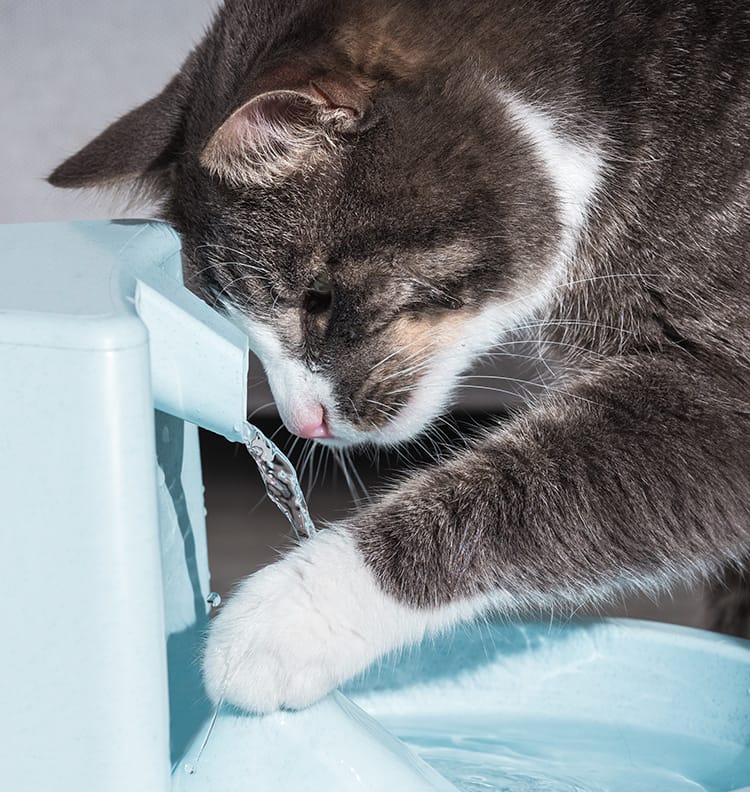
We don’t recommend water fountains for cats or dogs, including the models designed to come apart for cleaning. Every fountain has narrow tubes, pump chambers and small compartments that can’t be fully scrubbed, and those are exactly where bacteria, biofilm and mold take hold. A ceramic, porcelain, stainless steel or glass bowl, washed daily, is the safer choice for every pet in your home.
Quick facts
Bacteria need four things to thrive: water, nutrients, moderate temperatures and time. A fountain supplies all four, around the clock.
Pumps, tubes and filters can’t be fully cleaned, even on fountains that come apart.
Biofilm and mold have to be physically scrubbed away. Bleach alone won’t reliably remove them, and bleach residue can end up in your pet’s drinking water.
In controlled studies with cats, fountains didn’t substantially increase how much they drank.
Our recommendation for cats and dogs: a ceramic, porcelain, stainless steel or glass bowl, washed and refilled daily.
Do pets really drink more from a water fountain?
Cats are drawn to movement and love drinking from the faucet, and plenty of dogs will happily lap at a running tap. So it only seemed logical that a recirculating fountain would get pets to drink more. A fabulous idea, right? Not quite.
When researchers actually measured it in cats, the results were underwhelming. In a 2010 study of 12 healthy cats, water intake from a fountain was only slightly higher than from a bowl, and not enough to meaningfully dilute their urine. A 2019 study comparing still, circulating and free-falling water found no meaningful difference in how much cats drank. We aren’t aware of comparable studies in dogs, but the hygiene problems below apply to every fountain, whichever pet is drinking from it.
Some pets do love moving water, and there’s a better way to give them that, which we’ll get to below. But the fountain itself isn’t delivering what the box promises, and it brings a hygiene problem a bowl never has.
Why do water fountains grow bacteria?
A fountain gives bacteria everything they need. Harmful bacteria thrive on four things: water, a source of nutrients, moderate temperatures and time. Water left standing for more than two days without a thorough cleaning can become a problem for your pet.
The nutrients arrive with every visit. Pets often drink right after eating, so small food particles fall into the water. Saliva goes in with every sip, and anyone who has watched a dog drink knows the water gets a generous helping. Cats bat at the stream with their paws, dogs step in the bowl or drop toys in it, and we all know where those paws have been.
Outdoor water stations have it even worse. Summer heat speeds up bacterial growth, and leaves, dirt and insects add more for bacteria to feed on.
Under ideal conditions, some bacteria can double their numbers in about 20 minutes. Given a few days, they settle onto surfaces and form biofilm: that slick, slimy layer you feel when you run a finger around the inside of a neglected bowl. Mold can take hold the same way.
Why can’t a water fountain be fully cleaned?
A fountain is a surprisingly complicated piece of equipment: a reservoir, a recirculating pump, and a network of tubes, compartments and filters. Many newer models advertise that they come apart for easy cleaning. The reservoir and bowl do. The narrow tubes, the inside of the pump and the small compartments around its moving parts don’t, at least not in any way you can reach with a brush.
That matters because biofilm and mold don’t rinse away. They cling to surfaces and have to be physically scrubbed off. Soaking the parts or running a cleaning solution through the unit may kill some of what’s on the surface, but it won’t reliably remove what’s anchored in places you can’t reach.
Whatever survives grows back, and it’s tougher than before. Research on biofilms shows they withstand disinfectants far better than free-floating bacteria do, so every partial cleaning can leave behind a colony that’s harder to kill. Meanwhile, your pet drinks water that has passed through it all day long.
Filters make it worse. Sponge and carbon filters trap debris, and bacteria and mold along with it. There’s no reliable way to sanitize a used one.
Why not just run bleach or peroxide through the fountain?
It’s tempting, but we don’t recommend it. Bleach can’t do the scrubbing that biofilm and mold require, and any residue left in those same hard-to-rinse tubes goes straight into your pet’s drinking water. You’d be trading one problem for another.
Can dirty water and dishes affect my pet’s health?
Most bacteria in your home are harmless, and your pets encounter them every day. The concern is a steady daily dose from a source where bacteria have been allowed to multiply unchecked.
Pet dishes are a bigger hygiene issue than most owners realize. In a 2022 North Carolina State University study, dog bowls became significantly cleaner when owners followed the FDA’s pet food handling and dish hygiene guidance, yet fewer than 5% of owners surveyed even knew that guidance existed.
Plastic dishes add another problem. Plastic scratches easily, and those tiny scratches trap bacteria and yeast. Plastic dishes are commonly linked to chin acne in both cats and dogs: blackheads, bumps or crusting where the chin touches the dish. Switching to a non-porous bowl is one of the first changes we suggest when a pet has chin acne.
Hydration matters for every pet, and water that smells or tastes off can put them off drinking. For cats, it’s also a urinary health issue. Stress is recognized as an important trigger for feline idiopathic cystitis (FIC), one of the most common causes of urinary problems in cats, and good hydration and a low-stress routine both support a healthy bladder. For dogs, steady access to clean water matters most after exercise and in hot weather.
What’s the best water bowl for cats and dogs?
We recommend only four materials, because they’re smooth, non-porous and can be scrubbed truly clean:
- Ceramic, with a lead-free, food-safe glaze
- Porcelain
- Stainless steel
- Glass
Skip plastic entirely. Replace any ceramic, porcelain or glass bowl that becomes chipped or cracked, since damaged surfaces trap bacteria just like scratched plastic. Plastic also contains micro-plastics which can cause a host of other issues.
For dogs, choose a bowl that’s heavy or has a non-slip base so it doesn’t tip or slide, and size it so your dog doesn’t run dry between refills. Large dogs and multi-pet homes do well with more than one bowl.
How should you clean your pet’s bowls?
A bowl’s biggest advantage over a fountain is that every surface is within reach of a sponge. Use that advantage every day:
- Empty the water bowl daily. Don’t just top it off.
- Scrub every surface with hot, soapy water and a clean sponge or brush. If the inside feels slick, that’s biofilm, so keep scrubbing until it feels squeaky clean.
- Rinse thoroughly so no soap is left behind.
- Refill with fresh water.
Wash food bowls at least daily too. The FDA recommends washing pet bowls and scoops with hot, soapy water after every use. Dishwasher-safe bowls can simply go in the dishwasher, and a spare set makes the daily swap easy. Outdoor bowls need the same care, and a fresh refill more than once a day in hot weather.
What if my pet loves moving water?
Some pets genuinely light up at running water, and you can give them that without a fountain. If you have a filtered tap or a reverse osmosis (RO) spout, turn it on to a gentle trickle in short bursts while your cat or dog is there to enjoy it. It’s fresh every time, there’s nothing hidden for bacteria to colonize, and many pets treat it as a game, which makes it great enrichment too.
Just remember to turn it off when playtime is over. Your pet won’t notice the water bill, but you will.
What kind of water should pets drink?
A good rule of thumb: if the water is good enough for you to drink, it’s good enough for your pet. We recommend water with a neutral pH of about 7, such as:
- Filtered tap water, with chlorine and fluoride removed.
- Spring water.
- Distilled or reverse osmosis (RO) water, which is free of minerals and heavy metals. We find it works well for adult cats that are no longer growing bone, and it may be worth discussing with your veterinarian if your cat has high blood calcium or phosphorus levels.
Please don’t give cats or dogs alkaline water. It can push urine pH in the wrong direction. For cats, a healthy urine pH generally falls between 6 and 6.5, and pH-modified water should only be used when your pet’s urine is outside the normal range, under veterinary supervision.
The same principles apply to ferrets. Ferret water bottles have the same hidden-parts problem as fountains, so if you use one, clean the sipper tube and ball daily, not just the bottle, or switch to a heavy ceramic or stainless steel bowl.
Remember that the water bowl is only part of the hydration picture. What your pet eats plays a role too. Our article on hydration and diet. You wouldn’t eat off the same plate day in and day out without washing it. Give your pet’s water the same courtesy.
Frequently asked questions
Are water fountains safe for cats and dogs? We don’t recommend them for either. Their tubes, pumps and filters can’t be fully cleaned, so bacteria, biofilm and mold can build up where you can’t reach them. A ceramic, porcelain, stainless steel or glass bowl washed daily is the safer option.
What if my fountain comes apart for cleaning? The reservoir and bowl come apart, but the narrow tubes and the inside of the pump still can’t be scrubbed. Biofilm and mold need physical scrubbing to be removed, so those hidden areas remain a problem.
Can I clean a pet water fountain with bleach? We don’t recommend it. Bleach won’t reliably remove biofilm or mold without scrubbing, and any residue left in hard-to-rinse parts ends up in your pet’s drinking water.
What is the best bowl material for cats and dogs? Ceramic with a lead-free, food-safe glaze, porcelain, stainless steel or glass. Avoid plastic, which scratches and traps bacteria and yeast. For dogs, a heavy bowl or one with a non-slip base helps prevent spills.
Can a plastic bowl cause chin acne in cats and dogs? Plastic dishes are commonly linked to chin acne in both cats and dogs, because scratches in the plastic trap bacteria and yeast. Switching to a non-porous bowl is a simple first step. If the acne doesn’t improve, see your veterinarian.
How can I get my pet to drink more water? Keep water fresh by washing and refilling bowls daily, and place bowls in a few spots around the house. Offer extra water after exercise and in hot weather. If your pet loves moving water, offer a gentle trickle from a filtered tap in short, supervised bursts.
Have a question about your pet’s water or diet? Our team is made up of real people who are happy to help — Contact Us.
Sources
Grant DC. Effect of water source on intake and urine concentration in healthy cats. Journal of Feline Medicine and Surgery. 2010;12(6):431–434. doi.org/10.1016/j.jfms.2009.10.008
Robbins MT, Cline MG, Bartges JW, et al. Quantified water intake in laboratory cats from still, free-falling and circulating water bowls, and its effects on selected urinary parameters. Journal of Feline Medicine and Surgery. 2019;21(8):682–690. doi.org/10.1177/1098612X18803753
Bridier A, Briandet R, Thomas V, Dubois-Brissonnet F. Resistance of bacterial biofilms to disinfectants: a review. Biofouling. 2011;27(9):1017–1032. doi.org/10.1080/08927014.2011.626899
Luisana E, Saker K, Jaykus L-A, Getty C. Survey evaluation of dog owners’ feeding practices and dog bowls’ hygiene assessment in domestic settings. PLOS ONE. 2022;17(4):e0259478. doi.org/10.1371/journal.pone.0259478
He C, Fan K, Hao Z, et al. Prevalence, risk factors, pathophysiology, potential biomarkers and management of feline idiopathic cystitis: an update review. Frontiers in Veterinary Science. 2022. pmc.ncbi.nlm.nih.gov/articles/PMC9257190